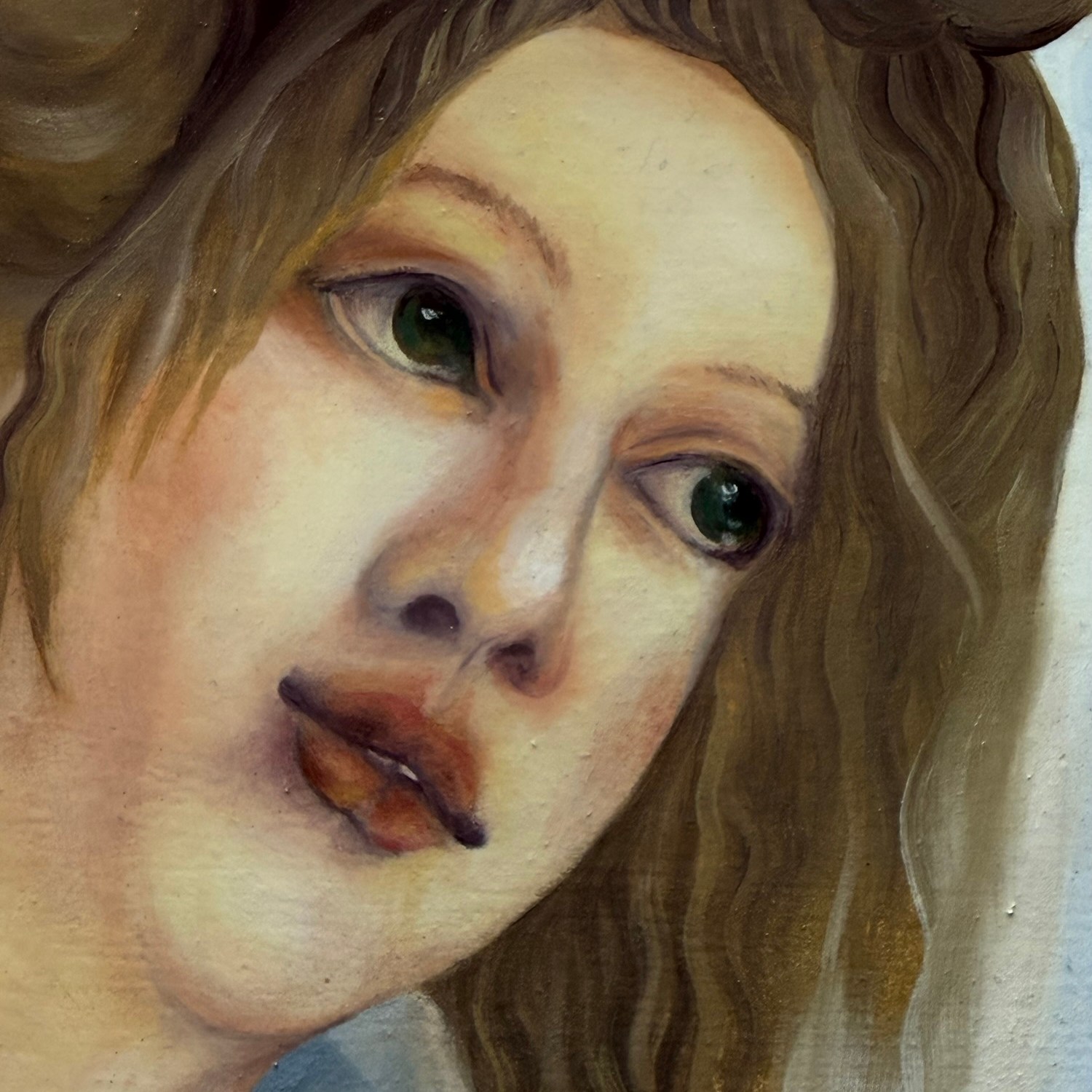
An Allegory of an Allgorythm
Artificial intelligence has become one of the defining forces of our time. Yet the questions that interest me are not primarily technical. I am less concerned with how algorithms work than with how they influence the ways we perceive, interpret, and organise the world around us.
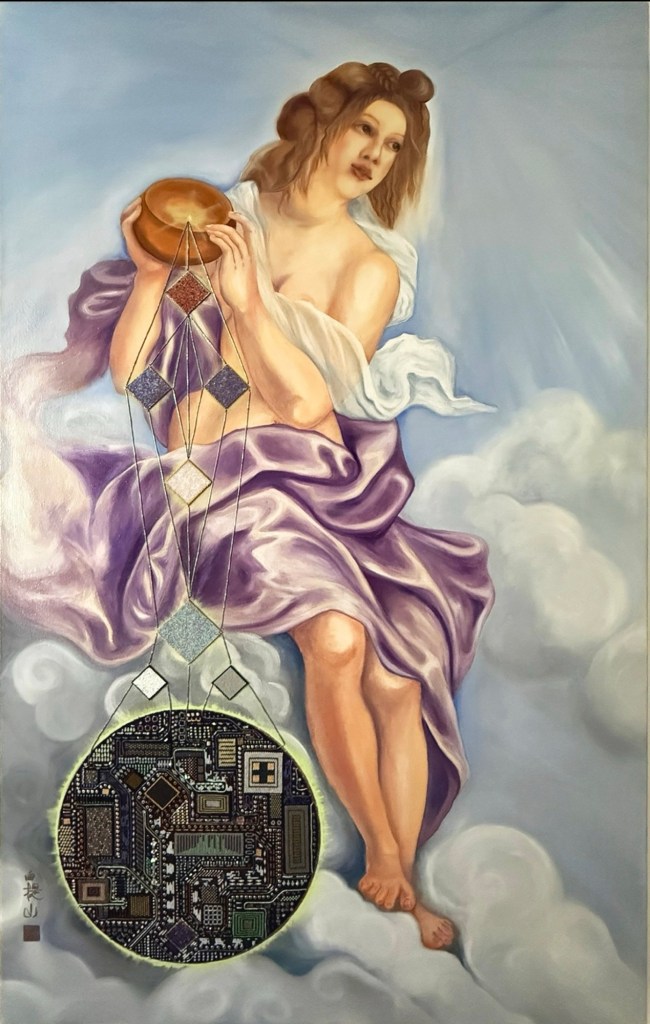
Emerging Tilt grew out of this reflection.
The title refers to a subtle shift — a gradual inclination that may initially go unnoticed. Inspired by Artemisia Gentileschi’s allegorical painting The Inclination, the work explores how the emergence of artificial intelligence is reshaping the relationship between knowledge, perception, and human agency.
In Gentileschi’s painting, a compass symbolises the inclination of the world. In Emerging Tilt, the compass is replaced by a tilted bowl. Rather than measuring an inclination, the bowl releases one.
From it descends a network of threads and geometric forms. These structures are inspired by the architecture of neural networks and deep-learning systems. Information flows through interconnected nodes, is transformed, condensed, and ultimately produces an outcome. Yet the forms remain deliberately ambiguous. They may be read as ornaments, crystals, constellations, or technological diagrams.
At the end of this network appears a world of circuits, processors, and electronic structures. This is not intended as a warning, nor as a celebration of technology. It is simply an acknowledgement of a reality that is increasingly woven into everyday life.
The central figure does not appear trapped or controlled by these systems. She is neither fearful nor triumphant. Instead, she observes with curiosity.
This attitude is essential to the work.
Public discussions about artificial intelligence are often framed through extremes — utopian promises on one side and existential fears on the other. Emerging Tilt seeks a different perspective.
Artificial intelligence is not merely a technology. It is becoming a new cultural landscape.
Like language, writing, printing, or the internet before it, AI is gradually transforming how knowledge is created, distributed, and understood. It influences not only what we know, but also how we come to know it.
The emerging tilt is therefore not a dramatic rupture. It is a subtle reorientation of human perception itself.
As an artist and conservator, I spend much of my time working with traces left behind by previous generations. Every object carries evidence of human choices, beliefs, and ways of seeing the world. In this sense, Emerging Tilt is also a reflection on the present moment.
What traces will our algorithms leave behind?
How will future generations understand the systems we are building today?
And how should we respond to a landscape that is still taking shape?
Not with fear.
Not with blind optimism.
But with curiosity, responsibility, and a willingness to look closely.
This text was developed through a series of extended conversations between the artist and ChatGPT, reflecting a collaborative process of dialogue, reflection, and refinement.


You must be logged in to post a comment.